
Artificial Grass Around Pools in Perth: Slip, Drainage, Salt Care
A pool is meant to feel effortless then reality hits: muddy feet, worn lawn edges, sand in the water, and slippery spots that make everyone a bit cautious. That’s why artificial grass around pool Perth has become a popular option for homeowners who want a clean, green look without constantly patching turf or fighting bare areas.
But “poolside artificial grass” isn’t a one-product decision. The outcome depends on three things: how slip is managed, how drainage is built, and how you handle salt/chlorine splash-over. Here’s what to get right.
1) Slip: what “safe around pools” really means
Let’s be clear: no outdoor surface is “non-slip” in every condition. Around pools, people are often barefoot and wet, which changes how surfaces behave.
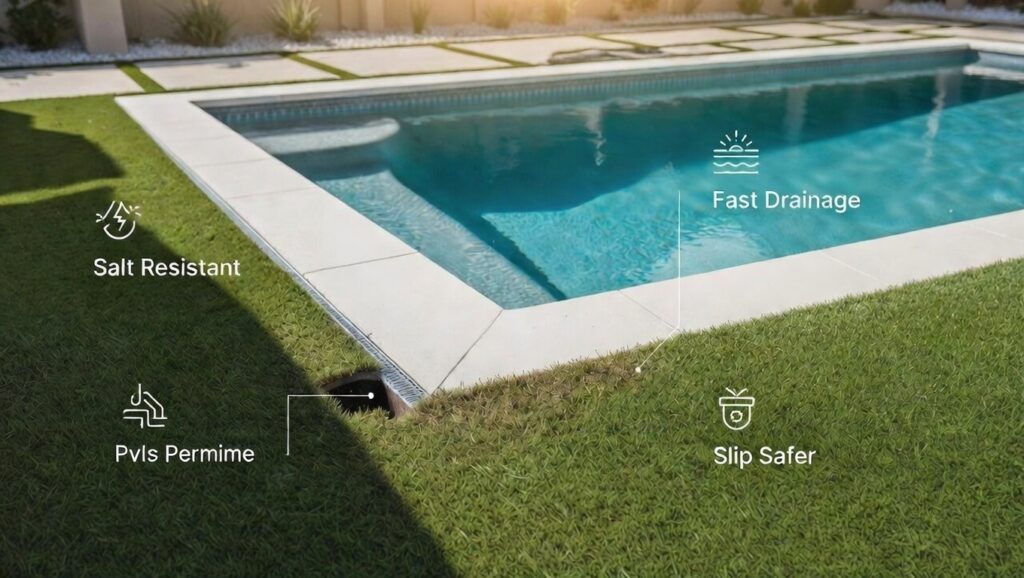
In Australia, AS 4586 is used to classify slip resistance of new pedestrian surfaces. For areas where people are likely to be barefoot and wet (like pool surrounds), the wet barefoot inclining platform test (Appendix C) is the relevant testing method and results in A/B/C classifications.
How to apply this practically to pool zones:
- If you have pavers/tiles/stone adjacent to the pool, ask your supplier for slip ratings suitable for wet barefoot areas (that’s where the standard is most commonly used).
- For artificial turf around pool, ask your installer/supplier what evidence they can provide about traction in wet use, and physically test a sample when wet (barefoot) where possible.
- Design also matters: avoid creating steep “runways” of wet turf down a slope toward the pool entry.
A useful reference point: TigerTurf notes that quality turf drains well, can remain slip-resistant, and doesn’t degrade with chlorine exposure but this still depends on product selection and installation detail.
2) Drainage: the difference between “drains” and “drains fast”
If you want fast draining synthetic turf, you’re really buying a system not just the grass.
A clear, industry-style explanation is that drainage relies on:
- Perforated backing (holes that let water pass through the turf), and
- A proper base layer underneath that allows water to move away instead of pooling.
Jack’s own installation process references crushed rock & compacting plus a weed barrier, which aligns with the “base does the real work” principle.
Vertical vs horizontal drainage (important around pools)
Most backyard installs use vertical drainage: water goes down through the turf and base into soil. But if your poolside zone sits over concrete or a hardstand, you may need horizontal drainage (graded surface directing water to drains).
This is also why “water resistant artificial grass” is a better phrase than “waterproof grass”: the turf isn’t meant to block water it’s meant to let water through and dry quickly. Jack’s balcony turf FAQ even calls out built-in drainage holes and quick drying after rain/cleaning.
Poolside drainage design essentials
- Maintain positive falls away from the pool coping toward a drain or garden edge.
- Avoid low spots near steps, gates, or outdoor showers.
- Keep drainage points accessible (don’t permanently seal them under turf edges).
3) Salt & chlorine care: keep the turf clean and fibres upright
Perth pools are commonly either chlorinated or salt-chlorinated. Either way, splash-out happens and it leaves residue.
TigerTurf notes quality turf doesn’t degrade with chlorine exposure.
For saltwater environments, FieldTurf’s maintenance guidance (for synthetic surfaces) notes that while surfaces are designed to withstand salt water, it’s essential to wash periodically to remove salt water deposits.
A simple “salt care” routine (Perth-friendly)
- Rinse with fresh water more often in peak swim season (and after big splash days).
- Brush fibres upright so the surface stays comfortable and looks consistent (especially in walk paths).
- If you see white, chalky residue (often mineral/salt deposit), a manufacturer-style approach is a diluted vinegar/water treatment then flush thoroughly SYNLawn’s care manual suggests vinegar/water for mineral deposits and brushing.
Design tips that keep the pool cleaner (less tracking)
A pool edge is a high-traffic, wet zone. Good design reduces mess before it becomes maintenance.
Build a “transition strip”
Consider a 200–300mm border of hardscape or stone between the coping and turf. It:
- reduces infill/fibre tracking into the pool
- gives a stable place to step when dripping wet
- makes cleaning easier
Limestone is a common Perth landscape material and Jack has a limestone service page—useful if you want a clean, modern border that complements turf.
Lock the edges down
Edges fail first near pools because people pivot, drag loungers, and cut corners. Aluminium edging helps maintain a crisp line and reduces lifting or fraying.
If you’re planning artificial turf around pool areas and want it to feel safe, drain properly, and stay tidy through Perth summers, Jack’s Synthetic Grass can recommend the right turf + install system (base, edging, and finish) for your pool layout. Book a measure and quote via the contact page.
Frequently Asked Questions
Most homes suit a mid-range pile for realism and practicality, then rely on density and yarn quality for spring-back and durability.
Not always, taller turf can flatten if density/support is weak. Height should match usage, then density should do the “premium feel” work.
Density reflects how many fibres are stitched in. Higher density usually looks fuller and holds up better in busy areas.
Look for UV-stabilised yarns. Common turf polymers include PE, PP and nylon, each with different feel and resilience.
Many pet areas do well with practical mid/shorter piles that are easier to rinse and groom, plus a drainage-friendly install.
Yes, test softness, recovery (spring-back), and backing visibility under pressure. If it mats easily, look for more density or a more resilient yarn system.


